
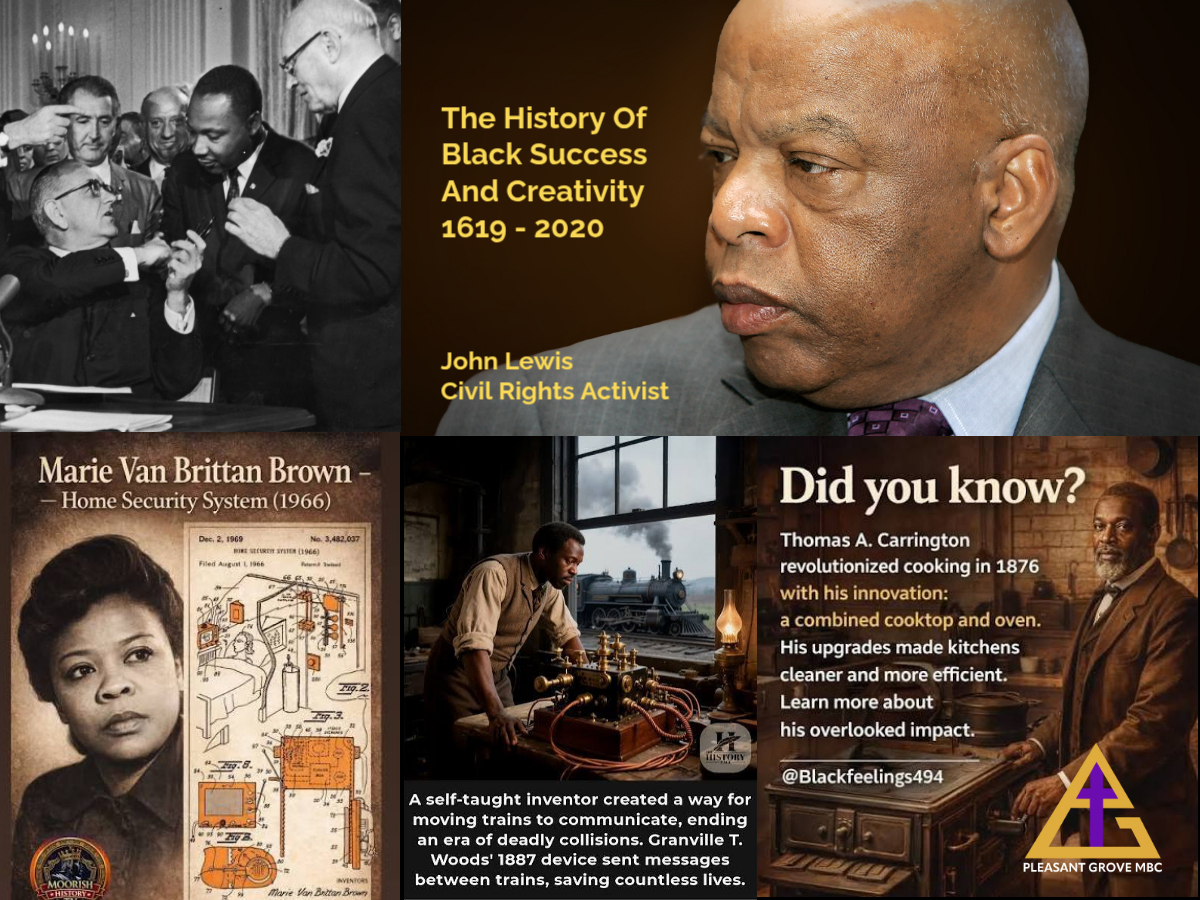
A Story of Faith, Resilience, Achievement, Innovation, and the Determination to Move Forward
When the history of Black America is told, the story too often begins and ends with slavery, segregation, discrimination, and struggle.
Those chapters cannot—and should not—be ignored. They are essential to understanding American history. But they are not the whole story.
The fuller story is also one of faith, family, education, entrepreneurship, invention, music, literature, leadership, community building, political action, and extraordinary creativity.
From 1619 through 2020, generations of African Americans faced barriers designed to restrict their freedom and opportunity. Yet they continually built institutions, created businesses, established churches, pursued education, produced art, developed inventions, defended the nation, organized communities, and challenged America to live up to its highest ideals.
For the Black Church, this history has special meaning.
The church was never simply a building where people gathered on Sunday morning. Throughout Black history, the church often became a sanctuary, school, meeting place, leadership center, cultural institution, organizing headquarters, and source of hope.
This is the history we celebrate: not simply how Black Americans survived, but how they created, achieved, led, built, worshiped, and transformed America.
1619 and the Beginning of a Long American Journey
In 1619, Africans arrived in English Virginia, marking an important early chapter in the history of people of African descent in what would become the United States.
Over the following generations, racial slavery developed into a vast economic and social system. Millions of Black men, women, and children lived under conditions in which their labor, movement, education, families, and futures could be controlled by others.
Yet enslavement never erased humanity.
African Americans maintained families and communities, practiced faith, preserved traditions, developed skilled trades, cultivated crops, created music, told stories, worshiped God, and passed knowledge from one generation to another.
Their labor contributed enormously to the development of the American economy.
But something equally important was developing spiritually.
For generations of Black Christians, biblical stories of deliverance carried tremendous meaning. The Exodus story of people moving from bondage toward freedom spoke directly to communities longing for liberation.
Faith provided something slavery could not easily destroy: hope.
That faith would eventually become one of the foundations of the Black freedom movement.
Emancipation: Freedom Opens New Doors
The Civil War transformed the nation.
President Abraham Lincoln’s Emancipation Proclamation took effect in 1863, and the 13th Amendment abolished slavery throughout the United States in 1865, except as punishment for crime.
Emancipation brought an extraordinary challenge: What would formerly enslaved people do with freedom?
Their answer was powerful.
They began building.
Families searched for relatives who had been separated by slavery. Communities established churches. Parents sought schools for their children. Black Americans purchased land, learned trades, created businesses, entered politics, established civic organizations, and pursued education.
Education became particularly important.
Newly emancipated African Americans viewed learning as a pathway toward independence and prosperity. During Reconstruction, Black communities worked aggressively to establish schools throughout the South. Many institutions that eventually became Historically Black Colleges and Universities grew from this determination to make education accessible to African Americans.
The first institution recognized today as an HBCU traces its origins to 1837, and dozens more were established during Reconstruction, when most American colleges restricted or prohibited Black enrollment.
From these institutions would come generations of teachers, ministers, physicians, attorneys, scientists, artists, business leaders, public officials, and community builders.
Education became more than personal advancement.
It became a form of empowerment.
The Black Church: More Than Sunday Morning
Alongside schools, another institution became indispensable to Black progress: the church.
Black churches became some of the first institutions African Americans could substantially control themselves.
Inside their walls, people worshiped—but they also organized.
Churches hosted community meetings, educational programs, political discussions, mutual-aid societies, leadership development, charitable efforts, and eventually civil rights organizing.
The minister often became one of the most influential leaders in the community.
But the strength of the Black Church extended far beyond the pulpit.
Mothers, fathers, deacons, trustees, musicians, teachers, ushers, missionaries, business owners, young people, and volunteers all contributed to institutions that served entire neighborhoods.
The Black Church taught generations an important principle:
Our circumstances do not have to determine our destiny.
That message would echo throughout the centuries.
Building Businesses Despite Jim Crow
The end of slavery did not bring an end to racial discrimination.
As Reconstruction faded, segregation and Jim Crow laws spread across much of the South. Black Americans faced restrictions in voting, employment, education, housing, transportation, and public accommodations.
Yet entrepreneurship continued.
African Americans established barber shops, grocery stores, insurance companies, banks, funeral homes, newspapers, restaurants, beauty businesses, medical practices, law offices, farms, theaters, construction companies, and countless other enterprises.
Men and women built businesses because entrepreneurship offered both economic opportunity and independence.
One of the most famous examples developed in Tulsa, Oklahoma.
Black Wall Street: A Community Builds Wealth
Tulsa’s Greenwood District became one of America’s most prominent Black business communities.
Known eventually as Black Wall Street, Greenwood contained Black-owned stores, theaters, professional offices, churches, schools, and other institutions. By 1921, the Smithsonian notes that the community included around 200 Black businesses.
Imagine what that represented.
Black families were not simply earning money.
They were creating an economic ecosystem.
A person could visit a Black doctor, hire a Black attorney, shop at a Black-owned store, attend a Black church, patronize Black entertainment establishments, and receive services from Black professionals.
Greenwood demonstrated what could happen when entrepreneurship, education, community, and ownership worked together.
In 1921, racial violence devastated Greenwood during the Tulsa Race Massacre. Homes and businesses were destroyed and lives were lost.
But even that destruction did not end Greenwood’s story.
Residents returned.
They rebuilt.
Businesses reopened.
The community rose again.
That chapter of history offers a powerful lesson: Black success has repeatedly demonstrated an ability to rebuild after enormous loss.
Creativity Changes American Culture
Black achievement was not limited to business and politics.
African American creativity profoundly changed American culture.
Music provides one of the clearest examples.
Spirituals, gospel, blues, jazz, rhythm and blues, rock and roll, soul, funk, hip-hop, and countless related styles carry significant influences from Black musical traditions.
During the early twentieth century, another cultural explosion emerged: the Harlem Renaissance.
Writers, musicians, painters, intellectuals, and performers helped redefine how Black identity and creativity were expressed publicly.
Figures such as Langston Hughes and Zora Neale Hurston became part of a remarkable generation of writers and artists whose work reached audiences across the country.
The Library of Congress describes the Harlem Renaissance as a period of extraordinary cultural activity and innovation among African American artists and writers.
Black creativity was becoming impossible for America to ignore.
The influence would only grow.
Jazz traveled around the world. Gospel transformed sacred music. Blues helped provide foundations for rock and roll. Black performers reshaped dance, theater, television, fashion, film, and popular culture.
Creativity became another declaration of freedom.
Innovation and Invention
African Americans also contributed significantly to American innovation.
Inventors and entrepreneurs developed technologies, products, processes, and businesses despite frequently facing limited access to capital and opportunity.
Garrett Morgan became both an inventor and entrepreneur, developing businesses while pursuing inventions and improvements to existing technologies. His story represents a broader tradition of Black innovation: seeing problems and finding solutions.
Innovation was not limited to laboratories.
Black farmers innovated.
Black craftsmen innovated.
Black beauticians innovated.
Black mechanics innovated.
Black musicians innovated.
Black business owners innovated.
Sometimes innovation means inventing a new device.
Other times it means finding a new way to serve a community when traditional institutions refuse to do so.
World Wars and the Demand for Equality
African Americans served the United States during both World Wars while returning home to a country that frequently denied them equal treatment.
That contradiction became increasingly difficult for America to defend.
Black veterans had worn the uniform, defended democracy, and sacrificed for their nation.
Many returned determined to claim the freedoms for which they had fought.
At the same time, the Great Migration transformed American cities as millions of African Americans moved from the rural South to cities throughout the North, Midwest, and West.
These movements changed politics, business, music, churches, neighborhoods, and American culture.
A new generation was preparing to challenge segregation directly.
The Civil Rights Movement: Ordinary People Doing Extraordinary Things
The Civil Rights Movement is often remembered through famous names—and those leaders deserve recognition.
But the movement was larger than any one person.
It included pastors, teachers, students, domestic workers, veterans, business owners, attorneys, parents, children, and ordinary citizens.
People organized boycotts.
Students conducted sit-ins.
Freedom Riders challenged segregation in interstate transportation.
Citizens registered voters.
Churches hosted meetings.
Families opened their homes.
People marched knowing they might be arrested, beaten, fired from their jobs, or worse.
Their courage changed America.
The Civil Rights Act of 1964
One of the movement’s greatest legislative achievements was the Civil Rights Act of 1964.
President John F. Kennedy had called for major civil rights legislation before his assassination in November 1963. President Lyndon B. Johnson continued pushing for its passage.
Congressional debate was fierce.
Southern opponents mounted an extended Senate filibuster. Debate over the legislation occupied the Senate for 60 working days. On June 10, 1964, the Senate voted 71–29 to invoke cloture, an extraordinary breakthrough for civil rights legislation. The Senate ultimately passed the bill 73–27.
President Lyndon Johnson signed the Civil Rights Act into law on July 2, 1964.
The law transformed the legal landscape of the United States.
Title II prohibited discrimination in public accommodations such as hotels, restaurants, and theaters.
Title VI prohibited discrimination under federally funded programs and activities.
Title VII prohibited employment discrimination and created the Equal Employment Opportunity Commission to help enforce federal employment protections.
The law attacked major pillars of legalized segregation and discrimination.
Its passage was not simply the achievement of Washington politicians.
It represented years of pressure generated by Americans who marched, organized, prayed, protested, registered voters, endured arrests, participated in sit-ins and Freedom Rides, and demanded change.
The political coalition that ultimately passed the legislation was bipartisan, bringing together congressional supporters from both parties while overcoming strong opposition, particularly among Southern lawmakers.
The Civil Rights Act was followed by additional landmark legislation, including the Voting Rights Act of 1965 and Fair Housing Act of 1968.
The legal structure of American society was changing.

John Lewis: From Protester to Congressman
Few lives connect the Civil Rights Movement and modern American public service as clearly as John Robert Lewis.
Born February 21, 1940, near Troy, Alabama, Lewis grew up in the segregated South.
As a young man, he embraced the philosophy of nonviolent protest associated with Dr. Martin Luther King Jr. and became deeply involved in the movement.
Lewis participated in the Nashville sit-ins challenging segregated lunch counters.
He joined the Freedom Rides of 1961, challenging segregation in interstate transportation.
He became chairman of the Student Nonviolent Coordinating Committee, commonly known as SNCC, serving from 1963 until 1966.
At only 23 years old, Lewis became the youngest major speaker at the 1963 March on Washington for Jobs and Freedom.
But one of the defining moments of his life came on March 7, 1965.
Lewis and hundreds of peaceful demonstrators attempted to march from Selma toward Montgomery, Alabama, advocating for voting rights.
As marchers crossed the Edmund Pettus Bridge, Alabama state troopers attacked them.
Lewis suffered a fractured skull.
The day became known as Bloody Sunday.
Images of peaceful Americans being brutally attacked shocked the nation. The events in Selma helped build national pressure for federal voting-rights legislation.
Later that year, President Johnson signed the Voting Rights Act of 1965.
Lewis continued serving the public long after the demonstrations of the 1960s ended.
He was elected to Congress in 1986 and represented Georgia in the U.S. House of Representatives from January 1987 until his death on July 17, 2020.
Across decades, Lewis remained closely associated with what he called getting into “good trouble”—the idea that conscience sometimes requires peaceful action against injustice.
His life became a bridge between generations.
From Civil Rights to New Possibilities
The decades following the Civil Rights Movement brought new opportunities—and new challenges.
African Americans increasingly entered professions and institutions from which earlier generations had been excluded.
Black Americans became CEOs, judges, physicians, engineers, professors, generals, mayors, governors, members of Congress, entrepreneurs, scientists, entertainers, athletes, authors, and technology leaders.
Black-owned businesses expanded.
Black culture continued influencing global music, fashion, entertainment, sports, media, and art.
African Americans reached positions that their ancestors could scarcely have imagined.
Yet progress did not mean every inequality disappeared.
Disparities and debates involving education, wealth, criminal justice, voting access, housing, health, employment, and opportunity continued into the twenty-first century.
History reminds us that progress is rarely a straight line.
Every generation inherits both accomplishments and unfinished work.
2008: A Historic Presidency
Another symbolic milestone arrived in 2008.
Barack Obama was elected the 44th president of the United States, becoming the first African American elected to the nation’s highest office.
Regardless of political affiliation, the historical significance was undeniable.
A nation that had once legally enslaved people of African descent had elected an African American president.
For millions of older Black Americans who had lived through segregation, the moment carried extraordinary historical weight.
Children saw possibilities that previous generations had only imagined.
2020: A Year of Reflection and Transition
By 2020, America was again engaged in intense national conversations about race, equality, policing, opportunity, history, and justice.
That same year, the nation lost John Lewis.
His death on July 17, 2020, marked the passing of one of the most recognizable remaining leaders of the 1960s Civil Rights Movement.
But the story did not end with him.
New generations were leading businesses, entering public service, creating technology, producing films, building organizations, launching nonprofits, serving churches, developing art, starting companies, and organizing communities.
The methods changed.
The tools changed.
The opportunities changed.
But the desire to build a better future remained.
Black History Is Also Black Success
We must teach the difficult chapters of Black history.
We should teach slavery.
We should teach Jim Crow.
We should teach lynching and racial violence.
We should teach discrimination.
We should teach the struggle for voting rights.
But we must never teach Black history as though Black people were only victims of history.
They were also makers of history.


They were inventors.
Entrepreneurs.
Pastors.
Teachers.
Scientists.
Farmers.
Musicians.
Soldiers.
Artists.
Doctors.
Attorneys.
Parents.
Authors.
Builders.
Organizers.
Public servants.
And believers.
Black Americans created institutions when existing institutions excluded them.
They created businesses when economic doors were closed.
They created schools when education was denied.
They created music that changed the world.
They built churches that strengthened communities.
They organized movements that expanded American democracy.
And generation after generation, they found ways to move forward.
The Church’s Role in the Next Chapter
This history matters to the church because the Black Church helped carry this story.
Our ancestors prayed in circumstances we can hardly imagine.
They built churches with limited resources.
They educated children.
They cared for widows.
They fed families.
They supported businesses.
They registered voters.
They developed leaders.
They created music.
They comforted the grieving.
They celebrated victories.
And when communities faced seemingly impossible circumstances, the church reminded people that God had not abandoned them.
That legacy creates responsibility for today’s church.
We should encourage entrepreneurship.
We should support education.
We should mentor young people.
We should preserve our history.
We should encourage creativity.
We should support families.
We should develop leaders.
We should strengthen our communities.
We should teach young people not only about what previous generations endured—but also about what previous generations accomplished.
A child who only learns a history of oppression may wonder where he or she fits into the future.
A child who learns a history of faith, creativity, intelligence, courage, entrepreneurship, invention, and leadership discovers something different:
I come from people who built things.
I come from people who created things.
I come from people who overcame things.
I come from people who changed things.
And therefore:
I can build something too.
From 1619 to 2020—and Beyond
Four centuries of Black history cannot be reduced to one article.
There are millions of stories.
Some belong to famous Americans whose names appear in textbooks.
Others belong to grandmothers, grandfathers, pastors, teachers, business owners, farmers, veterans, musicians, deacons, mothers, fathers, and neighborhood leaders whose names may never appear in a history book.
Their lives mattered too.
They built the foundation upon which later generations stand.
From the first generations of Africans in colonial America, through emancipation and Reconstruction, through Jim Crow, the Harlem Renaissance, Black Wall Street, the Great Migration, the Civil Rights Movement, the Civil Rights Act of 1964, the Voting Rights Act, and into the twenty-first century, one truth remains clear:
Black history is American history.
But Black history is also a history of success and creativity.
It is a history of people who refused to allow oppression to have the final word.
It is the story of communities that turned adversity into achievement.
It is the story of people who transformed pain into music, exclusion into entrepreneurship, ignorance into education, segregation into organization, and faith into action.
For the church, perhaps the greatest lesson is this:
We honor those who came before us not simply by remembering what they endured, but by continuing what they built.
There are businesses still to create.
Children still to educate.
Families still to strengthen.
Art still to produce.
Leaders still to develop.
Communities still to transform.
People still to serve.
And ministry still to do.
The history from 1619 to 2020 reminds us how far the journey has come.
The future asks a different question:
What will we build next?
Pleasant Grove Missionary Baptist Church — PGWay Church
Honoring the past. Strengthening the present. Building the future.
Research: Sis. Betty Bell
Blog/Graphics/Copywriting: Carlfred Giles